90-Day Business Goals: The Accountability System That Works
Nobody runs a marathon without knowing where the finish line is. Business works the same way. Without a clear goal, you’re just running.
It was 1978.
Like most people in Britain at the time, James Dyson used a basic upright vacuum cleaner to clean his home.
These machines worked by sucking up dirt and trapping it inside a paper bag. But the more you used it, the fuller the bag got.
And the fuller the bag, the harder it was for air to pass through.
It was like trying to breathe through a cloth that kept getting thicker. Eventually, the suction would die completely, and the vacuum would be almost useless.
The only fix was to stop what you were doing, open up the machine, pull out the dirty bag, and swap it for a new one.
It was messy, annoying, and it kept happening over and over again.
Dyson had had enough.
He ripped off the bag, attached a rough cardboard funnel to the machine, and built his prototype on the spot. His idea was to use spinning air to separate the dirt instead of a bag, to avoid blockage.
From that moment, his process was simple: build it, test it, learn from it, then build the next one.
He made 5,127 prototypes before he got it right, and he learned something from every single one.
Each stage had one clear goal.
Each goal led to the next, until he achieved what he wanted to.
Today, his net worth is estimated at $16 billion.
In any business, you need to start with the vision and build it into stages.
These stages are what form goals.
Then, you set a deadline for each one, and execute until the big result arrives.
Why 90-Day Goals Matter
A 90-day goal gives a business owner a structured, measurable commitment with a firm deadline attached.
Business owners who use the 90-day structure break big objectives into smaller, achievable steps and execute them one at a time.
They build each stage with precision, giving every goal above it the strongest possible base to land on.
The way we do it at Mastermind9 is by placing as much focus on how a goal gets executed as it does on what the goal is.
We break every goal down into clear, actionable steps with deadlines and accountability built in from day one.
The 90-day approach keeps short-term focus and long-term vision working together at the same time.
How to Set 90-Day Goals
When business owners define one clear goal first, every action that follows has a single direction.
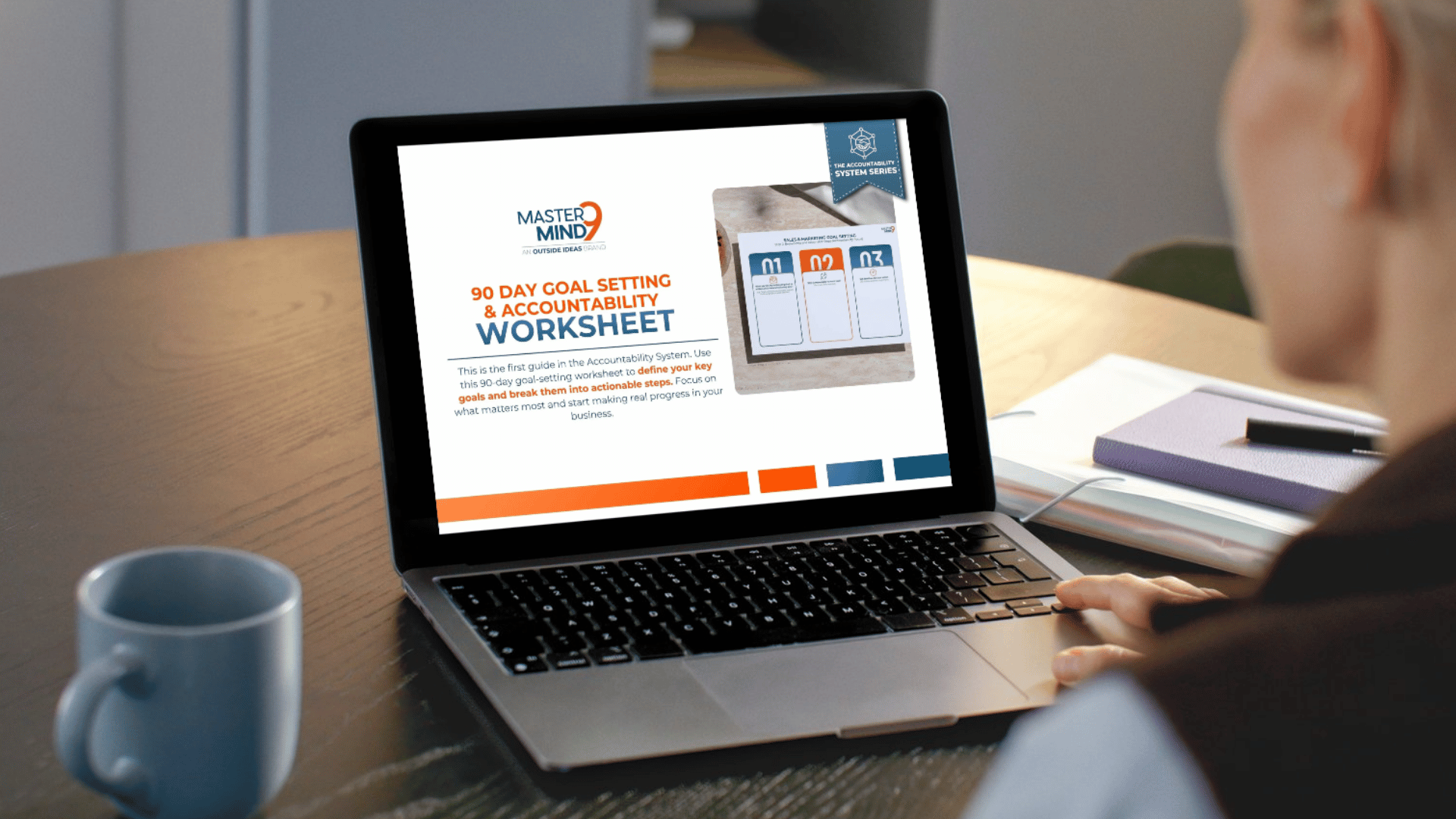
The 90-Day Goal Setting Worksheet breaks that goal into clear monthly, weekly, and daily actions with deadlines attached to each one.
Deadlines force action and stop goals from drifting into vague intentions.
A short timeline also forces business owners to focus on what produces the most impact and cut everything that does not.
When to Set 90-Day Goals
Business owners who set 90-day goals at the start of each quarter give themselves a clean slate and enough time to make meaningful progress before the next review.
When you assess where you stand before the new quarter begins, you move from being reactive to proactive from day one.
Where Should You Set Your 90-Day Goals?
To set your 90-day goals, you need to be a quiet space where you can think clearly.
A private office, a co-working space, or a booked meeting room all work equally well.
Where Do You Start?
We’ve created a 90-day goal-setting and accountability template, which helps you to define you have set those goals.
You’ll get the tools to stay ahead, track the right things, and know exactly where to focus for the best outcomes.
There’s a section for sales and marketing goals, business development goals, and personal development goals.
In each, you get to understand what you want to achieve, why it’s important, when you want to achieve it, and how you’ll feel when you achieve it.
You’ll assign responsibilities and set deadlines for each action to ensure accountability.
What the Business Theory Says
Setting structured, time-bound goals will always outperform vague ambitions.
In 1954, Peter Drucker introduced Management by Objectives in his book The Practice of Management. He argued that clarity, accountability, and alignment across every level of a business are what separate organisations that grow from those that stagnate.
Then, in 1981, George T. Doran formalised the SMART framework, giving business owners a practical tool to ensure every goal is Specific, Measurable, Achievable, Relevant, and Time-bound.
The 90-day accountability sheet applies both frameworks directly.
Ninety days maintains urgency, produces meaningful progress, and helps you to have clear outcomes and deadlines for each goal.
Download your free 90 Day Accountability and Goal-Setting WorksheetNow that you have understood The Accountability System and why it starts with setting the right goals, you can download the worksheet here.
We’re on a mission to be relentlessly helpful to business owners. We would love to hear what you think of the template! What did you think? What was useful and what wasn’t?