

Childcare for Business Owners: What Help Is Available in the UK?
September 2026 marks a full year since the 30 funded hours scheme went fully live in England.
For most working parents, that should be the good news story of the last twelve months. For business owners, the story is a little more complicated than that.
Here is what that scheme actually means. If you are a working parent in England with a child aged nine months up to starting school, the government now pays for 30 hours of nursery a week. That runs during term time, not the whole year.
Every child in the country goes back to school within the same few days each September.
Every parent feels the reset that comes with it.
For business owners, going back to school does not solve the childcare problem. The six weeks of summer holiday cover gets replaced by a school day that ends at 3pm, when the working day usually does not.
Why Childcare Is Hard For Everyone

The UK has some of the most expensive childcare in the developed world relative to income.
The funded hours help enormously where they apply, but they only run for 38 weeks a year, not 52, so summer holidays and inset days are not covered.
Coverage before and after school, for children with extra needs, and for parents working outside a standard nine-to-five, remains the weakest part of the whole system.
None of that is unique to business owners. It is the backdrop everyone is working against.
Why It Is Harder Again When You Run The Business
Here is where it gets more specific.
If an employee’s childcare falls through, they ring their manager. If you are the business, there is no manager to ring. The work simply does not happen that day.
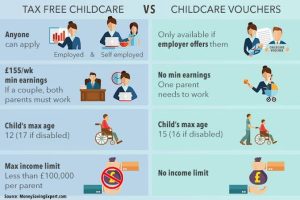
To get the 30 hours or Tax-Free Childcare, you have to prove you are working enough. In practice that means earning at least what 16 hours a week at minimum wage comes to, around £200 a week right now.
If you can show that on a payslip, you qualify, simple as that. If you run your own business and your income moves around, it gets harder, because you have to prove it all over again every three months, not just once.
Say a big invoice lands in March, but April and May are quiet. If your income dips below that £200 a week mark in the quarter you happen to reconfirm, you could lose the funding, right when you need it most.
There is also a ceiling on the other end. Earn over £100,000 a year yourself and you lose the funding completely, for both schemes.
This is about what you personally earn, not your household. Say you earn £90,000 and your partner earns £70,000. You are both fine, because neither of you alone has crossed £100,000. But if you alone earn £105,000, you lose it, even if your partner earns nothing at all.
Grow your business past that point, and the funding disappears at the exact moment things start going well.
There is one more gap worth knowing about. If you are employed, your employer might help cover childcare through a workplace scheme. If you are self employed, you cannot claim childcare as a business expense at all, even though it is often the only reason you are able to work in the first place.
And the flexibility that comes with running your own business cuts both ways. You can rearrange your day around a poorly child and nobody needs to sign it off. But nothing else stops for you either, and there is no one else the business can lean on while you are doing it.
What Childcare Options Actually Exist For Owners
Tax-Free Childcare
Tax-Free Childcare is open to self employed parents as well as employees. The government adds £2 for every £8 you put in, up to £2,000 a year per child, or £4,000 if your child is disabled, and it can run alongside the 30 hours.
The Startup Grace Period
New business owners get a genuine break here. There is a grace period of 12 months where the minimum earnings rule does not apply, which matters most in that first shaky year of trading.
Universal Credit
If your income is lower, Universal Credit includes a childcare element that can cover up to 85% of registered costs, and it is available to self-employed parents too.
Flexible Childminders
Childminders are usually far more willing to flex around an irregular week than a nursery timetable ever will be, which matters more to a business owner than almost anyone else.
Limited Companies
If you run a limited company, there may be additional options worth a proper conversation with your accountant, since the rules differ from those for a sole trader.
How A Mastermind Group Actually Helps
None of the schemes above solve the part that actually wears people down, which is feeling like you are the only one who has not worked this out yet.
Our groups are made up of accountants, parents, and business owners navigating the same complex problems you are.
That is really the whole value of sitting down with people like that regularly. A problem that feels enormous and personal when you are carrying it alone tends to shrink the moment someone else says, oh, that happened to me too.
The Takeaway
Childcare in the UK was built around a fairly traditional idea of a working day. Running a business rarely looks like that, and the system has not quite caught up yet.
None of that is a reason to muddle through it alone. The business owners who cope best with all of this tend to be the ones who talk about it out loud, with people who understand exactly what they are juggling.
Come and see what that actually looks like.
Book a free virtual tour, and we will show you round.
Let us know how you have made this work in your own business. We read every reply.
Onwards and upwards our friends, Pete, Sarah, and the Mastermind9 team